The Digital Evolution of Obituaries: Why Online & Social Media Memorials Are Changing How We Remember
 Cameron Williamson
The Digital Evolution of Obituaries: Why Online & Social Media Memorials Are Changing How We Remember
In recent years, how we honor loved ones has shifted dramatically. Once, newspaper obituaries were the principal, sometimes the only, public way to announce a passing. Now, with the internet and social media, families have richer, more flexible, and more enduring ways to create tributes. This article explores why online obituaries and memorials are becoming the preferred way to honor someone’s life—and why they often surpass traditional print notices in impact.
1. A More Personal & Lasting Story
Online memorials allow for depth in ways print often can’t. According to The Advocate’s “Benefits of Online Memorials”:
“Online memorials are more personal and create a more lasting, meaningful life story than a regular obituary. They offer a number of ways that people can share their thoughts, feelings, and memories about a person.” The Advocate Obituaries
This includes photos, videos, stories, links, even charities associated with the person. As The Advocate notes, unlike printed obituaries published for just a few days, online memorials let friends and family continue adding memories and personal tributes over time. The Advocate Obituaries
2. Faster, Broader Reach
One of the biggest advantages of online and social media obituaries is how quickly news can spread.
Online, you can share via email, messages, and social networks instantly. No waiting for the next day’s paper.
In “The Pros and Cons of Publishing an Online Obituary,” Tranquility Cremation points out that online obituaries allow broader sharing via social media platforms, which helps ensure more people learn of the obituary and any service details. Tranquility Services
Social media tools also allow for updates or corrections (for instance, last minute service info), which print may not accommodate once published. Love Lives On+1
3. Interactive Mourning & Community Support
Online memorials are not just announcements—they become gathering places.
Guestbooks or comment sections let family, friends, and acquaintances share condolences, stories, and memories. AdPerfect describes this as “connecting families and friends … sharing memories alongside the obituary … providing connection for anyone that reads the obituary.” AdPerfect
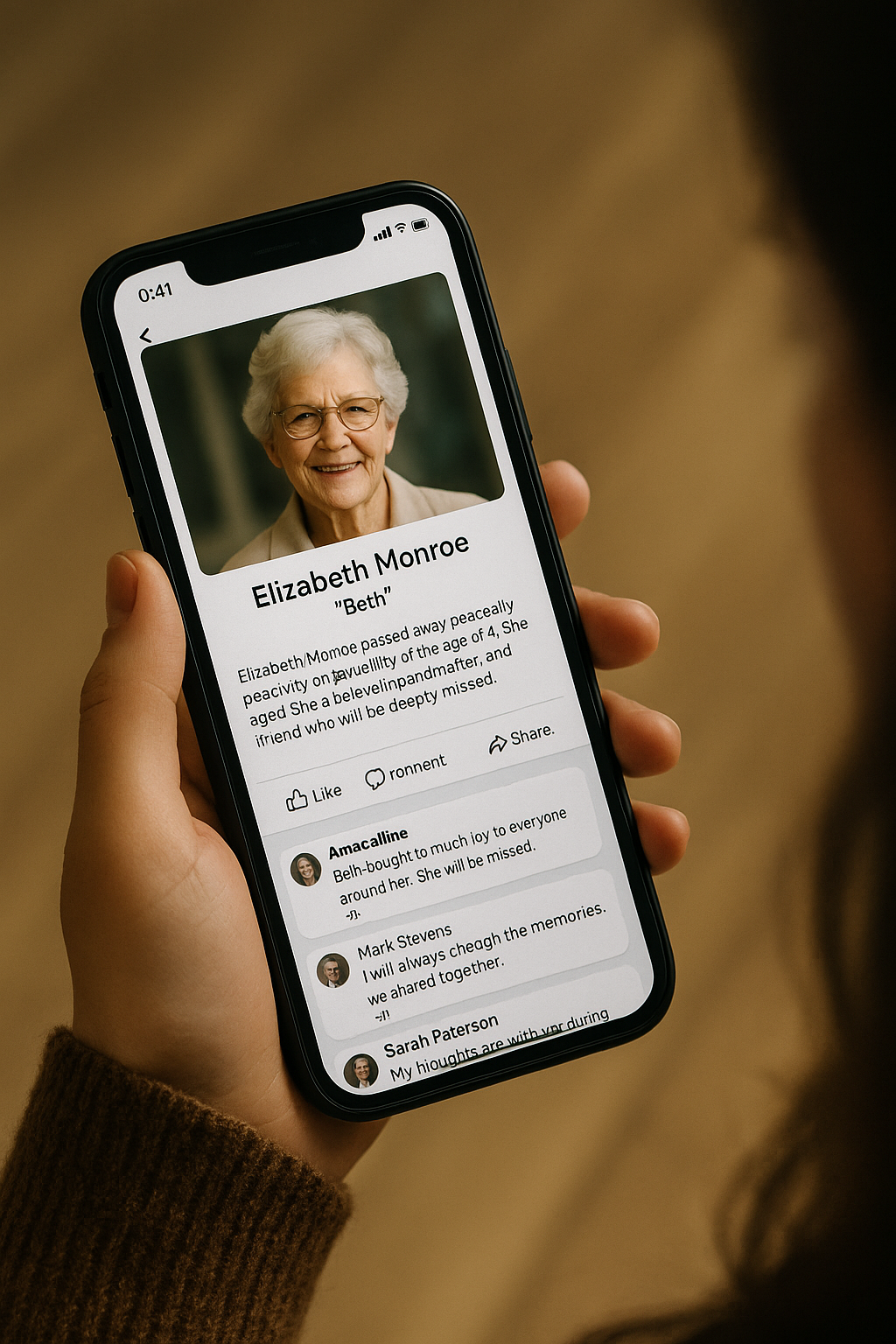
Social media pages or groups offer collective mourning. WVFDCOA.org remarks on how funeral services and memorials leverage these platforms to build a network of support, letting people post photos, memories, even virtual tributes from far away. WVFDCOA
4. Control, Flexibility & Cost
With online memorials, families often retain more control over how a tribute looks, how long it lives, and how expensive (or not) it becomes.
Tranquility Cremation lists as advantages: more control over layout and design, ability to include photos, videos, multimedia, while print often restricts layout, color, or length. Tranquility Services
Print obituaries typically charge by column inch and may charge extra for photos or special formatting. Online memorials are often much more affordable, or even free, depending on the platform. Love Lives On+2Beyond the Dash+2
Also, online memorials can be updated, edited, or expanded (if desired), whereas print is final when published. Reporters' Lab+1
5. Historical Record & Longevity
One criticism of print-only obituaries is that they are ephemeral; after publication, newspapers are disposed, lost, or deteriorate. Digital records have the potential to last.
From Reporters Lab at Duke: Online obituaries (and especially guest books) offer a “public forum for the bereaved.” They allow for richer portraits of the deceased than what newspapers’ professional constraints often permit. Reporters' Lab
Also, The Advocate points out that online memorials “can be an ongoing testament … long after the passing of a loved one.” The Advocate Obituaries
6. The Role of Social Media in Modern Memorials
Social media platforms significantly amplify the impact of memorials.
WVFDCOA.org details how platforms such as Facebook and Instagram have become spaces not only for announcing death but for sharing life—images, stories, and real-time updates. Funeral homes and services are increasingly using social media to inform, console, and connect. WVFDCOA
The reach of a shared post is often much wider than a print obituary; friends, distant relatives, and online acquaintances can engage. There’s emotional importance to seeing responses and messages from many people whose lives intersected with the deceased. Ballard-Sunder Funeral & Cremation discusses how posting obituaries on social media provides an “outflowing of support … hearing memories … even just a brief ‘I’m sorry for your loss’.” Ballard-Sunder Funeral & Cremation
7. Possible Limitations & Considerations
To be fair and balanced, here are some caveats to online memorials:
Audience access: Some older or less digitally connected family members may prefer or only see printed notices. Print still has reach in certain demographics or regions. Love Lives On+1
Privacy & moderation: Online memorials may invite comments, including unpleasant ones. Platforms and families need tools or policies to manage or moderate content. Love Lives On+1
Archival permanence: Some digital platforms may rely on paid hosting or may have policies that can change. If a platform fails, loses funding, or shuts down, archives can be lost. Maintaining control (downloading, backing up) is wise. Love Lives On+1
8. Fictional Case Comparison: Print vs. Online Memorial (Updated)
Scenario A – Traditional Print Obituary only
Sarah Miller’s family submits a print obituary to the local newspaper. It’s published once, in black and white, and includes her basic life details, the funeral service time, and a short list of family survivors. Those who do not buy the paper or who live outside the local area won’t see it. There’s no place for photos or memories beyond what the family could write in the space allotted.
Scenario B – Online Obituary + Social Media + Guestbook
Sarah’s family publishes her obituary on an online memorial platform. They upload photos of her, a video clip from her favorite concert, and link to a charity she supported. Friends from college, neighbors, and even distant relatives post memories and stories. Someone digitally preserves her favorite poems, and her profile remains accessible long after the funeral. The family is able to share the memorial link via social media, email, and messaging apps, allowing many more people to remember, engage, and support.
The online version is not just an announcement—it becomes a memorial that grows, sustains, and connects.
9. Integrating Tools Like RemembrLink Obituary Writer
When grief weighs heavily, writing an obituary feels harder than it should. That’s where tools like RemembrLink Obituary Writer help:
It gives structure and prompts so you don’t have to build from blank page.
Helps you incorporate multimedia (photos, videos) and guestbook/comment features.
Ensures that your online memorial is designed to be shareable, lasting, and deeply personal.
Final Thoughts
The evolution of obituary traditions reflects how technology is reshaping memory and grief. While print obituaries have noble history and still hold value—especially for those who prefer physical mementos—online obituaries and social media memorials offer advantages that are hard to ignore:
greater reach,
richer storytelling,
more emotional connection,
more control, and
often lower cost.
If honoring a loved one is your goal—and keeping their memory alive—digital memorials allow you to do so with compassion, breadth, and depth.
Search
Latest Blogs